California homeowners 55 and older have a property tax tool that most buyers never hear about: Proposition 19 lets them carry their Prop 13 base year value into a replacement home anywhere in the state, and the same measure reshaped what happens to an inherited home's assessment. Approved by voters in November 2020, Proposition 19 made two changes on two different dates: the parent-child exclusion limits took effect February 16, 2021, and the base year value transfer became operative April 1, 2021. This guide covers both rules with the figures current for 2026, the forms to file, and the deadlines that decide whether the savings survive.
Every rule below is attributed to a named source with an access date of November 26, 2026, drawn from the California State Board of Equalization, the California Department of Tax and Fee Administration, and county assessor guidance. This is education, not legal, tax, or financial advice: the assessor for the county where the property sits is the authority on a specific claim, and the figures that matter for a particular transaction come from that office and from a tax professional, not from a general article.
The one-line summary
Under Proposition 19, an eligible homeowner 55 or older can transfer the assessed base year value of their principal residence to a replacement home bought or built within two years of the sale, anywhere in California, up to three times: a replacement of equal or lesser value keeps the old base intact, and a more expensive replacement adds only the dollar difference to it. Separately, since February 16, 2021, an inherited home keeps the parent's assessment only if it was the parent's principal residence and becomes the child's, with the value sheltered capped at the parent's base plus an indexed exclusion that currently stands at $1,044,586. Both savings require a written claim filed with the county assessor on time; neither happens automatically.
What Proposition 19 actually changed
Proposition 19, the Home Protection for Seniors, Severely Disabled, Families, and Victims of Wildfire or Natural Disasters Act, was approved by California voters on November 3, 2020, and certified on December 17, 2020. It amended Article XIII A of the California Constitution, which is where Prop 13 lives, and its two main changes took effect on separate dates: the new parent-child and grandparent-grandchild exclusion rules became operative February 16, 2021, and the expanded base year value transfer became operative April 1, 2021. The distinction matters because each part has its own forms, deadlines, and effective dates.
The backdrop is Prop 13. Under that system, a home's taxable assessed value starts at its base year value, the value at the time it last changed ownership (or its 1975 base for homes held that long), and grows no more than 2% per year. A change in ownership normally triggers a reassessment to current market value, which is why a longtime owner can pay tax on a small fraction of what a new buyer would. Proposition 19 created two exceptions to that change-in-ownership reassessment: a transfer tool for older, disabled, and disaster-affected homeowners, and a narrower exclusion for inherited homes.
Who qualifies for the 55+ base year transfer?
Three groups qualify under the base year value transfer, per the Board of Equalization's guidance: a person at least 55 years old at the time the original home is sold (for a married couple, only one spouse needs to be 55 or older), a person who is severely and permanently disabled, and a person whose home was destroyed or substantially damaged in a wildfire or natural disaster. In every case the original home must be the claimant's principal residence, meaning the owner is eligible for the Homeowners' Exemption on it, and the replacement home must become the claimant's principal residence as well.
The geographic and lifetime rules are what make this different from the old Props 60 and 90, which limited transfers to replacements within the same county (or a county with an ordinance allowing cross-county transfers) and to one transfer per lifetime. Under Prop 19 there is no county restriction: the replacement can be anywhere in California, and an eligible homeowner may transfer base year value up to three times in a lifetime. Transfers already used under Props 60, 90, or 110 do not count against the three, and a disaster victim may transfer once per disaster event without it counting either.
The two-year window and the three-year claim deadline
Two clocks run on this transfer, and they are easy to confuse. The first is the eligibility window: the replacement home must be purchased, or new construction of it completed, within two years before or two years after the sale of the original primary residence. Buyers are allowed to purchase first and sell later, as long as the original home sells within two years of the replacement purchase. That is a meaningful change from the tighter rules some older programs carried, and it makes a downsizing move practical when the new home must be secured before the old one closes.
The second clock is the claim deadline. The claimant files Form BOE-19-B, Claim for Transfer of Base Year Value to Replacement Primary Residence, with the assessor of the county where the replacement home is located. The claim must be filed within three years of the purchase or completion of new construction of the replacement, or before the replacement is sold or transferred to a third party, whichever comes first. The Board of Equalization is clear that late claims generally receive only prospective relief, meaning the savings start from the date the claim is actually filed, not retroactively. Filing on time is the whole game.
How the transfer math works
The value rule is where the savings are made. If the replacement home is of equal or lesser value than the original, the original's factored base year value transfers to the replacement in full, with no increase. The new home is assessed as if it had been purchased at the old base, and the tax bill follows the base, not the market price.
If the replacement is more expensive, the difference in full cash value is added to the transferred base, dollar for dollar, under Article XIII A, section 2.1(b) as amended. A worked example makes it concrete, and the numbers are illustrative arithmetic, not a particular property:
- Original factored base year value: $250,000. Original full cash value at sale: $1,000,000.
- Replacement purchased for $750,000, equal or lesser value: the $250,000 base transfers in full. The assessed value stays $250,000.
- Replacement purchased for $1,200,000, a greater value: the new base is $250,000 plus the $200,000 difference, or $450,000.
At the 1% base levy that anchors California property taxes, those three outcomes illustrate the stakes: about $2,500 a year on the transferred $250,000 base, about $4,500 a year on the $450,000 adjusted base, versus about $12,000 a year on a full reassessment at $1.2 million. The actual bill adds voter-approved bonds and local assessments, and in Irvine, Mello-Roos and community facilities district charges can ride along, as this journal's Irvine property tax guide explains. The point of the illustration is the structure: the transfer is a permanent reduction in the assessed value that the annual 2% inflation factor then grows from, not a one-year credit.
The 105% and 110% rules, briefly
One detail in the statute surprises most readers. The phrase "equal or lesser value" is measured against thresholds that depend on when the replacement is acquired relative to the sale, per the Board of Equalization's letter to assessors on the claim rules. A replacement purchased before the sale of the original must have a full cash value no greater than 100% of the original's full cash value to qualify for the full transfer. A replacement purchased within the first year after the sale may go up to 105%, and within the second year after the sale, up to 110%. Within those limits the full base transfers with no reduction; above them, the greater-value difference rule applies.
The practical takeaway is a small cushion: a seller who buys a replacement within the first year after closing can spend up to 5% more, and up to 10% more in the second year, without losing the full base year value. The exact comparison is made by the assessor using the full cash values on file, so the numbers to rely on are the assessor's, not a round guess at list price.
What changed for inherited homes
The second half of Proposition 19 replaced the broad parent-child exclusion that Props 58 and 193 had created. Before February 16, 2021, a child could inherit a parent's home and keep the parent's assessed value regardless of whether the home was a rental, a second home, or anything else. After that date, that unlimited exclusion is gone, and a narrower rule applies to transfers between parents and children (and grandparents and grandchildren), whether by will, trust, or gift.
The family home still qualifies, with conditions. The property must have been the parent's principal residence, and it must become the child's principal residence. The child generally must move in within one year of the transfer and file the Homeowners' Exemption claim, Form BOE-266, with the county assessor. A rental property, second home, or any other non-principal-residence property inherited on or after February 16, 2021 receives no exclusion at all: it is reassessed to market value on the transfer. Transfers that occurred on or before February 15, 2021 continue to be governed by the old Props 58 and 193 rules, so the date of the transfer, not the date a family starts planning, is what picks the regime.
The $1 million exclusion, indexed for 2026
Even for the family home, the exclusion now has a ceiling. The child may keep the parent's factored base year value, and that value is sheltered only up to an additional exclusion amount set by statute: $1,000,000, adjusted every two years for inflation. For transfers occurring between February 16, 2025 and February 15, 2027, the adjusted exclusion amount is $1,044,586, per the Board of Equalization and county assessor guidance. Market value above the parent's base plus the exclusion is added to the assessed value.
An example clarifies the line. If a parent's factored base year value is $300,000 and the home's market value at transfer is $1,500,000, the assessed value becomes $1,500,000 minus the $1,044,586 exclusion, or about $455,414, rather than the full $1,500,000. The family keeps the tax advantage on roughly the first $1.34 million of combined base and excluded value, and the excess reassesses. At Orange County price levels, where Irvine attached homes trade in the range of the comparison set around this property, the cap is frequently the binding number, which is why heirs should compute the exact figure with the assessor rather than assume the whole value is protected.
The claim is Form BOE-19-P, Claim for Reassessment Exclusion for Transfer Between Parent and Child Occurring On or After February 16, 2021, filed with the assessor of the county where the property is located. The deadline is within three years of the transfer date or before the property is transferred to a third party, whichever is earlier, or within six months of the mailing of a supplemental or escape assessment notice. A late claim generally receives only prospective relief, so an unclaimed exclusion can quietly become an unclaimable one. Grandparent-grandchild transfers use the parallel Form BOE-19-G.
What this means for Irvine attached-home buyers
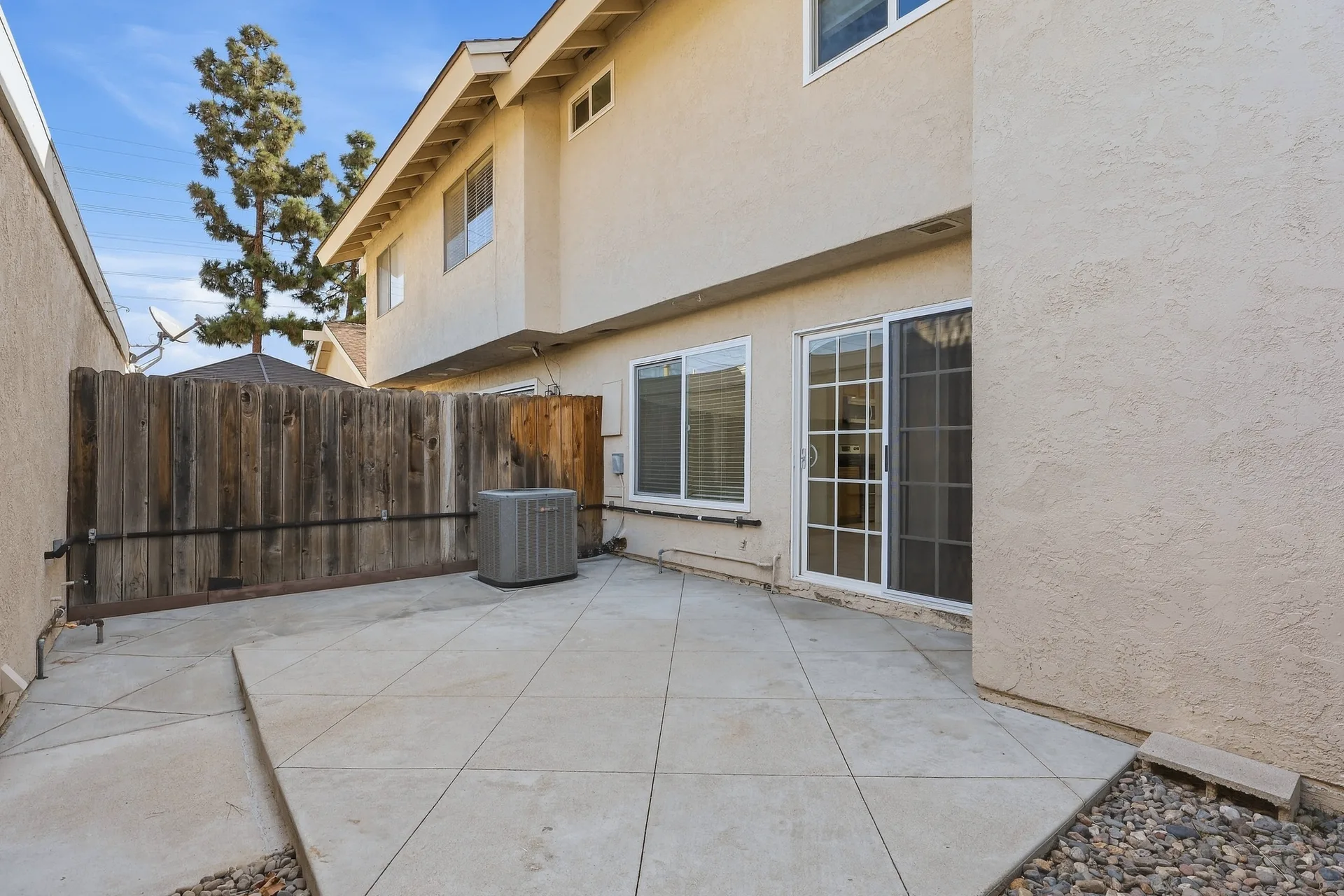
For buyers and sellers in Irvine's attached-home market, Proposition 19 shows up in two ways. The first is the downsizing move. Because Prop 13 keeps assessed values low for long-held homes, an owner who bought decades ago can have a base year value far below the home's market value, and that gap is exactly what the transfer carries forward. A condo or townhome qualifies as a replacement dwelling just like a single-family house, so moving from a larger Orange County home into an attached home like 8 Silverwood, listed at $810,000 with its private patio and attached garage, can bring a much lower property tax bill along, provided the age, timing, and principal-residence rules are met. The transfer changes only the assessment: the association dues, mortgage, and insurance are untouched by it.
The second way is inheritance planning. Irvine families who expect to pass an attached home to children face the February 16, 2021 rules, and the exclusion must be claimed, occupied, and documented. An heir who keeps a condo as a rental, or who delays moving in beyond the one-year mark, can lose the exclusion entirely. Because the stakes are a reassessment to market value at Orange County prices, the planning conversation is worth having before the transfer, not after the assessment notice arrives.
Two things this transfer does not do are worth keeping straight. First, it does not remove the monthly ownership costs of an attached home: at 8 Silverwood, the listing data references the Doe Trail Condo Association at approximately $582 per month and the Deerfield Community Association at approximately $351 per quarter, figures that also appear on the site's Market Intelligence page and should be independently verified, and those dues continue regardless of the tax base, as this journal's guide to California HOA rules explains. Second, it does not decide financing: an attached home still has to clear condo project approval, insurance, and reserve questions before loan programs apply, the subject of this journal's condo financing explainer. The tax transfer is one lever in a larger ownership picture, and a valuable one for the right buyer.
A practical checklist for 2026
Whether the move is a 55+ transfer or an inheritance, the steps that protect the savings are concrete:
- Confirm eligibility before the sale: the claimant's age at the time of sale, the principal-residence status of both homes, and for couples, that at least one spouse is 55 or older.
- Keep the purchase and the sale inside the two-year window in either direction, and document both dates with closing statements.
- File Form BOE-19-B with the assessor of the county where the replacement is located within three years of the purchase, before the replacement is resold, and ideally within the same tax year as the move.
- For an inherited family home, file Form BOE-19-P within three years (or before a third-party transfer, whichever is earlier), move in within one year, and file the Homeowners' Exemption (BOE-266) to verify principal-residence status.
- Run the specific numbers with the county assessor and a tax professional: the assessor's office computes the transferred base, the equal-or-lesser threshold that applies to the timing, and the indexed exclusion figure in force on the transfer date.
- Ask your agent the questions that shape the move, but remember the claim is filed by you: an agent can frame the property-tax consequences of a purchase, but the assessor and your tax advisor are the ones who make the numbers official.
The common thread across both parts of Proposition 19 is that nothing happens automatically. The transfer and the exclusion both require a written claim, a qualifying residence, and a deadline that is actually met. For a homeowner or a family that plans ahead, the payoff is a property tax bill that tracks a decades-old base instead of today's market, and in Irvine that can be the difference between a home that pencils and one that does not.
Sources and data notes
The rules, figures, and deadlines in this article are drawn from the named references below, each with an access date of November 26, 2026:
- California State Board of Equalization, Proposition 19 overview and FAQ, for the operative dates of the two parts (parent-child changes February 16, 2021; base year value transfer April 1, 2021), the form numbers, and the parent-child claim deadlines. boe.ca.gov/prop19
- California Department of Tax and Fee Administration, Proposition 19 Home Protection Act FAQ, for the certification date (December 17, 2020) and the two operative dates of the measure's tax provisions. cdtfa.ca.gov
- Board of Equalization Publication 800-4 (Taxpayers' Rights Advocate), for the base year value transfer eligibility groups, the principal-residence requirement, the three-transfer lifetime limit, and the filing rules. boe.ca.gov/pub800-4.pdf
- Board of Equalization Letter to Assessors 22051, for the 100%, 105%, and 110% equal-or-lesser-value thresholds keyed to when the replacement is acquired relative to the sale, and the claim filing guidance for Form BOE-19-B. boe.ca.gov/lta22051.pdf
- Board of Equalization Letter to Assessors 2021/019, for the greater-value rule: the difference between the replacement's full cash value and the original's full cash value is added to the transferred factored base year value. boe.ca.gov/lta21019.pdf
- San Francisco Assessor-Recorder, Proposition 19 Fact Sheet for Seniors, for the base year value transfer summary and the dollar-for-dollar greater-value adjustment. sf.gov fact sheet
- Los Angeles County Assessor, Proposition 19, for the parent-child principal-residence requirements, the one-year occupancy rule, the Homeowners' Exemption filing, and the $1 million indexed exclusion. assessor.lacounty.gov
- San Diego County Assessor, Parent to Child Exclusion, for the one-year move-in requirement and the reassessment consequence for property that does not qualify. sdarcc.gov
- Sonoma County Assessor, Parent/Child Transfer Exclusion, for the inflation-indexed exclusion amount of $1,044,586 in effect for transfers from February 16, 2025 through February 15, 2027. sonomacounty.gov
- Santa Cruz County Assessor, Proposition 19, for the transfer rules, the three-times lifetime use, and the two-year sale and purchase window. santacruzcountyca.gov
Data notes: the operative dates (February 16, 2021 and April 1, 2021) and the December 17, 2020 certification date follow the Board of Equalization and the California Department of Tax and Fee Administration. The two-year sale-and-purchase window and the three-year claim deadline for Form BOE-19-B follow the Board of Equalization guidance and the statutory condition in Revenue and Taxation Code section 69.5. The 100%, 105%, and 110% equal-or-lesser thresholds follow Letter to Assessors 22051. The greater-value adjustment as base plus the full cash value difference follows Article XIII A, section 2.1(b) and Letter to Assessors 2021/019, and the worked example of a $250,000 base, a $1,000,000 original value, and a $1,200,000 replacement producing a $450,000 base is illustrative arithmetic at those assumptions. The parent-child exclusion figures, including $1,044,586 for transfers from February 16, 2025 through February 15, 2027, follow the county assessor sources cited above. The 1% base levy illustration ignores voter-approved bonds, Mello-Roos, and other local charges, and is not an actual tax bill. The 8 Silverwood list price of $810,000, the Doe Trail Condo Association fee of approximately $582 per month, and the Deerfield Community Association fee of approximately $351 per quarter come from public listing data for MLS NP26199481 and the site's Market Intelligence page and should be independently verified. This article is education, not legal, tax, or financial advice; consult the county assessor and a tax professional for a specific claim.
Explore More of 8 Silverwood
Continue into Market Intelligence, the Neighborhood guide, Property Resources, or the photo gallery for additional property information, buyer resources, and local context.