Property taxes are the largest recurring cost of an Irvine home after the mortgage, and for a new buyer they almost always start higher than the neighbor's bill, because California reassesses a home to full market value when it changes hands.
The mechanics come from Proposition 13: a purchase resets the assessed value to what you paid, the base tax rate is capped at 1% of that value, voter-approved bond debt adds a little more on top, and the total bill cannot grow faster than 2% a year after you own it. On top of the recurring bill, many buyers face a one-time supplemental assessment after closing, and some parts of Irvine carry Mello-Roos community-facility taxes.
This guide walks through each piece with 2026 figures from named sources, works a transparent example at 8 Silverwood's $810,000 list price, and closes with a checklist a buyer can act on. It is background for knowing what to ask, not tax advice and not a guarantee of any parcel's bill.
The one-line summary
For a newly purchased Irvine home, budget roughly 1.1% of the purchase price per year in general property tax, plan for a possible one-time supplemental bill after close, and add whatever community association fees apply to the specific parcel. Woodbridge, where 8 Silverwood sits, carries no Mello-Roos according to the city's published district list, but the only way to know for sure is the parcel's own tax bill.
Start with the assessed value: your purchase price becomes the base
Under Proposition 13, a change of ownership is a reappraisal event. When you buy, the county assessor sets the property's assessed value at its market value, which in practice is normally your purchase price. That figure becomes the home's new "base year value," and it is the number the tax rate is applied to.
From that base, the assessed value can grow no more than 2% per year, tied to the California inflation factor, and it is not revalued annually. Only a change of ownership or new construction triggers another reappraisal, according to the California State Board of Equalization's guidance on how property is assessed.
This is why two nearly identical Irvine homes can carry very different tax bills. A long-time owner may still be taxed on a base from a decade or more ago, while a new buyer is taxed on today's price. The new bill is not an error; it is the system working as designed, and it is one reason buyers should estimate their own bill rather than assume a neighbor's figure.
The 1% levy, the extras on top, and Orange County's real rate
The base property tax rate is capped at 1% of assessed value. On top of that 1%, the bill includes voter-approved debt, typically general obligation bonds for schools and other districts, plus any special assessments that apply in the property's tax rate area. The combined rate varies by tax rate area, which is why two cities, or two parts of the same city, can differ.
Orange County's combined rates, as published by the Orange County Auditor-Controller for fiscal year 2025-26, run roughly 1.03% to 1.10% of assessed value depending on the tax rate area. Market guides that track the county, including Ownwell, put Irvine's typical effective rate near 1.03% to 1.11%, with a median around 1.11%.
A worked example makes this concrete. At 8 Silverwood's $810,000 list price, the 1% base levy alone is about $8,100 per year, or about $675 per month. At a combined effective rate near 1.1%, the general property tax is closer to $8,900 per year, about $742 per month. These are illustrative budgeting figures, not the property's actual bill: the county sets assessed value when the sale closes, and the precise rate comes from the parcel's tax rate area code on the county bill.
Will you get a supplemental tax bill after closing?
Often, yes, and it is the most common surprise in a California purchase. A sale is a "supplemental event": the assessor revalues the property from its old base to your purchase price, and the difference is taxed separately, prorated from the first day of the month following the change of ownership through the end of the fiscal year on June 30, per the California State Board of Equalization.
Two timing details matter. If you buy between January 1 and May 31, you can receive a second supplemental bill covering the entire following fiscal year, because the January 1 tax roll has already been set. And because the supplemental is new tax on new value, it is generally not covered by your mortgage impound account: the Orange County Treasurer-Tax Collector advises that supplemental taxes are usually paid separately by the owner, and the bill is mailed to you, not to your lender.
Two offsets soften the picture. At closing, escrow typically prorates the current tax year, crediting the buyer for taxes the seller already paid covering the days the buyer now owns the home. And the supplemental bill only covers tax on the increase from the old assessed value to the new one, so in a market where the prior base was already close to the sale price, the bill is small. The practical move is to ask your escrow officer for an estimate of the supplemental before you close, so a first-year bill is a plan, not a surprise.
What is Mello-Roos, and does Woodbridge have it?
Mello-Roos is shorthand for a Community Facilities District, formed under the Mello-Roos Community Facilities Act of 1982. A local agency creates a district with defined boundaries, and property owners within it vote to impose a special tax that funds infrastructure, schools, parks, or services and helps repay district bonds. The tax appears as its own line on the county property tax bill, is not based on the property's value, and carries a recorded lien against parcels in the district.
In Irvine, Community Facilities Districts are concentrated in the newer master-planned villages and the Great Park area. Sources that track Irvine districts put annual CFD special taxes roughly in the $1,500 to $5,400-plus range in newer villages, and higher in Great Park neighborhoods, areas where the total effective rate can reach about 1.4% to 2.1% of value instead of the roughly 1.1% a non-Mello-Roos parcel pays.
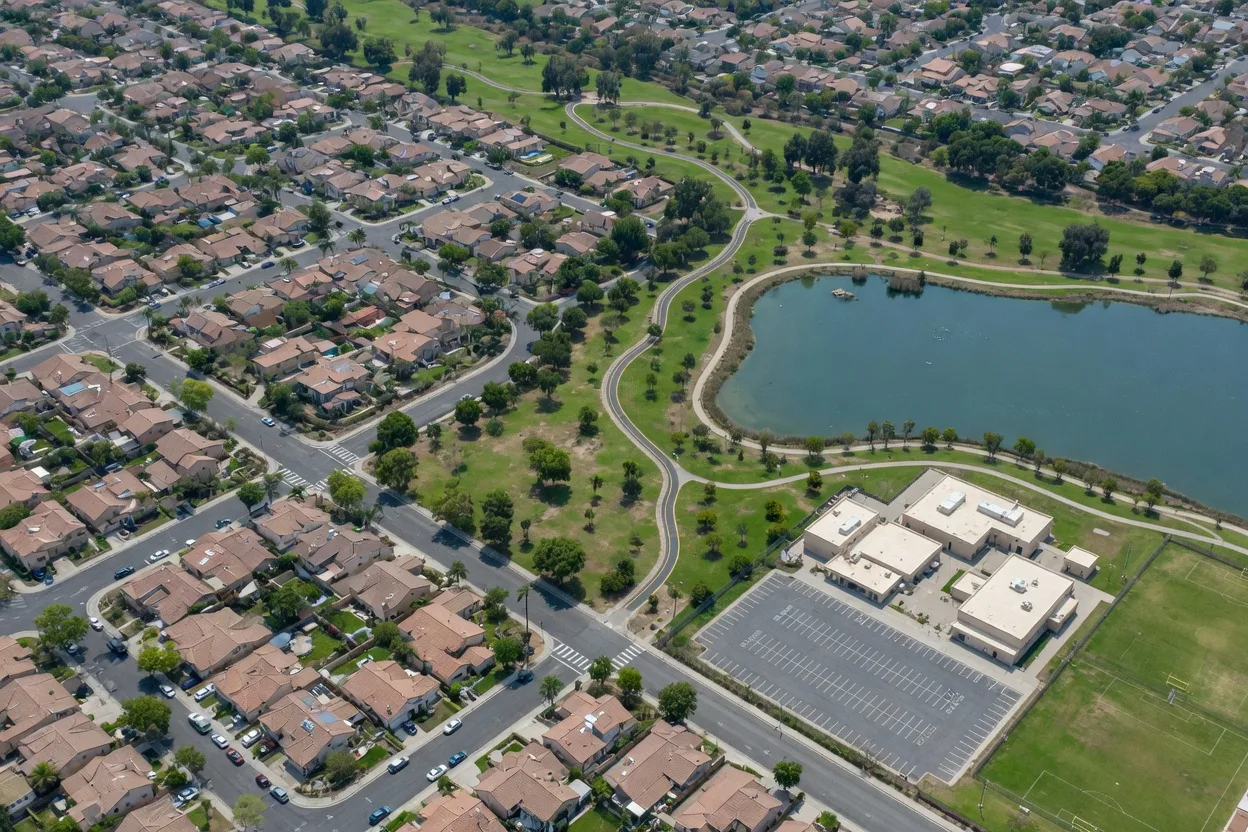
Woodbridge is a different case. The village was built largely in the 1970s and 1980s, before the 1982 act created most districts, and the City of Irvine's published list of Community Facilities Districts and 1913/1915 act assessment districts does not include Woodbridge. Multiple Irvine-focused sources confirm that Woodbridge homes carry no Mello-Roos special tax. The caveat matters: these taxes attach to individual parcels, so before relying on that for a specific address, check the parcel's own county property tax bill and the seller's disclosure package.
What do Woodbridge community association fees actually cover?
Property tax is not the only recurring cost of ownership. Woodbridge runs on a village association model: a master homeowners association fee, around $157 per month in 2026 according to Irvine-area sources, funds the village's well-known amenities, including the lakes, beach clubs, pools, and tennis courts. Sub-association fees within a village can add to that, and attached-home complexes may carry their own assessments for common areas, reserves, and insurance.
For context on the Deerfield area around 8 Silverwood, the October market roundup in this journal noted a Deerfield Community Association fee near $351 per quarter within the comparison set of nearby attached homes. What applies to any specific parcel is set out in the CC&Rs, the resale package, and the association's current budget, so the resale documents are the place to confirm the number rather than assume it.
For an attached-home buyer these fees deserve double attention, because the lender may review the association too. The condo financing explainer in this journal covers the project-level questions worth asking, including reserves and association insurance.
The Homeowners' Exemption you have to file yourself
California gives owner-occupants a small but real tax break: the Homeowners' Exemption removes $7,000 of assessed value from a qualifying primary residence, saving about $70 per year. The catch is that it is not automatic. You file a claim, form BOE-266, with the Orange County Assessor after you move in.
Timing affects the benefit. Filing by February 15 delivers the full exemption for that tax year, while a filing from February 16 through December 10 delivers 80% of it, per the State Board of Equalization. New owners can also file within 30 days of the supplemental assessment notice to apply the exemption to the supplemental bill. Most new owners receive the application automatically within about 90 days of recording their deed, and the form is free.
A buyer's checklist for the tax side of an Irvine purchase
None of this requires becoming a tax expert. It requires asking the right questions and reading the parcel-level documents before an offer. In rough order:
- Pull the current property tax bill for the parcel and read the line items: the 1% levy, voter-approved debt, any special assessments, and the tax rate area code. Your agent or the seller can supply it.
- Get the resale and HOA package, and confirm what community association fees apply to this exact home, not a neighboring complex.
- Confirm Mello-Roos status against the City of Irvine's district list and the county bill. Never assume it from the address alone.
- Ask your escrow officer for an estimated supplemental assessment, and budget to pay it outside the impound account if your lender does not.
- Run the full monthly picture at current numbers: mortgage, roughly 1.1% property tax, homeowners insurance, HOA and community fees, and utilities. The Financing Perspectives area on the Market Intelligence page models scenarios side by side.
- File the Homeowners' Exemption with the Orange County Assessor after close, and set a calendar reminder to do it before the February 15 deadline for the full benefit.
- Re-verify the current rate and inventory picture at the moment you make an offer, because both move month to month.
The companion pieces in this journal fill in the rest of the picture. The October market data shows where attached-home prices and the 30-year rate stand, and the condo financing guide covers the association, reserves, and insurance questions a lender may raise. Tax rates and special districts change through elections and new development, so treat any figure here as a point-in-time estimate and confirm the parcel-level numbers at the moment of your offer.
Sources and data notes
Every figure in this article is attributed to a named source with an as-of date. The primary sources are:
- California State Board of Equalization, "Supplemental Assessment," accessed October 21, 2026. boe.ca.gov
- California State Board of Equalization, Publication 800-10, "How Property Is Assessed for Property Tax Purposes," accessed October 21, 2026. boe.ca.gov
- Orange County Auditor-Controller, "FY 2025-26 Property Tax Rates," September 2025. ocauditor.gov
- Ownwell, "Irvine, Orange County, California Property Taxes," Irvine effective-rate data, accessed October 21, 2026. ownwell.com
- City of Irvine, "Community Facilities District and 1913/1915 Act Assessment Districts," accessed October 21, 2026. cityofirvine.gov
- City of Irvine, Great Park Community Facilities Districts, accessed October 21, 2026. cityofirvine.org
- Orange County Assessor, "Homeowners' Exemptions," accessed October 21, 2026. ocassessor.gov
- Orange County Treasurer-Tax Collector, "Supplemental Property Taxes FAQ," accessed October 21, 2026. octreasurer.gov
- JVM Lending, "Orange County, CA Property Taxes: A Homeowner's Guide," accessed October 21, 2026. jvmlending.com
- Regina Chen Group, "HOA Fees in Irvine, CA," Woodbridge Village Association master-fee context, accessed October 21, 2026. reginachengroup.com
Data notes: county tax-rate ranges, CFD ranges, and the Woodbridge master-fee figure summarize what the cited sources publish and are point-in-time; tax rates and special districts change by election and by new development. Parcel-level figures, including Mello-Roos status and any community association fee, must be verified against the actual county property tax bill and the resale documents for the specific address. Bedroom, bathroom, and square footage figures for 8 Silverwood are from public listing data for MLS NP26199481 and should be independently verified. This article is education, not tax, legal, or financial advice, and not a representation of any parcel's bill.
Explore More of 8 Silverwood
Continue into Market Intelligence, the Neighborhood guide, Property Resources, or the photo gallery for additional property information, buyer resources, and local context.