Buying a condominium involves many of the same financing questions as buying any other home: income, credit, down payment, monthly payment, and overall affordability.
But there can be another layer.
With a condo, the lender may need to evaluate not only the buyer and the individual residence, but also aspects of the condominium project itself. That can include the homeowners association, insurance, reserves, owner concentration, delinquent assessments, litigation, physical condition, and other project characteristics.
That is why condo financing is worth thinking about earlier in the buying process, not as a warning, but as another piece of due diligence.
Why can financing a condo be different from financing a single-family home?
A condominium purchase can require the lender to evaluate both the borrower and aspects of the condominium project, including HOA finances, insurance, reserves, delinquencies, litigation, physical condition, and other eligibility requirements.

Why can condo financing be different?
A simple way to think about it is:
The borrower matters. The individual property matters. And the condominium project may matter too.
Fannie Mae specifically notes that the quality and eligibility of mortgages secured by condominium units can be affected by characteristics of the overall project, which is why lenders may need to determine whether the project meets applicable eligibility standards. Freddie Mac similarly evaluates project characteristics such as financial viability, ownership structure, commercial use, litigation, and physical condition.
That does not mean every condo purchase goes through exactly the same review. The required review depends on the property, the project, the loan program, and the transaction itself.
It does mean that a buyer can be financially well-qualified and still have questions that need to be answered about the condominium project.
What can a lender look at?
The exact review varies, but several topics come up repeatedly.
HOA assessment delinquencies
For example, under Fannie Mae's current Full Review requirements, no more than 15% of the total units in a project may be 60 days or more past due on common expense assessments. Freddie Mac also uses the 15% delinquency threshold in applicable project-review standards and identifies excessive delinquent assessments as an area that can require additional review or a waiver.
Why does that matter?
Because HOA assessments fund the shared financial obligations of the community. A significant level of unpaid dues can affect the association's ability to operate, maintain common areas, fund reserves, and meet other obligations.
Reserves and the HOA budget
Lenders may also look at whether an association is adequately planning for future expenses.
Under FHA condominium guidance, a project's reserve account generally must be funded at a level equal to at least 10% of 12 months of unit assessments, unless an acceptable reserve study supports a lower amount.
Reserves matter because roofs, exterior components, infrastructure, common areas, and other shared elements eventually require repair or replacement.
A healthy-looking property today does not eliminate the need to plan for tomorrow.
Insurance
Condominium financing can also involve a review of the association's master insurance coverage.
Fannie Mae's current project requirements include standards for master property insurance and general liability coverage, and lenders remain responsible for confirming that applicable insurance requirements are satisfied.
This has become an increasingly important part of condominium lending because the individual unit owner's policy is only one part of the insurance picture.
Physical condition and deferred maintenance
The condition of the overall project can matter as well.
Current Fannie Mae and Freddie Mac standards address projects with critical repairs, significant deferred maintenance, inspection issues, and related project conditions. Freddie Mac, for example, states that when required inspection information cannot be obtained, the lender may be unable to establish project eligibility.
Again, this is not about assuming something is wrong with a condominium community. It is about understanding that the lender may need information beyond the four walls of the unit being purchased.
Litigation
Pending litigation can also affect financing, depending on what the dispute involves.
A minor matter and litigation involving structural defects or significant financial exposure are not necessarily viewed the same way. Both Fannie Mae and Freddie Mac include litigation among the project characteristics that may affect eligibility or require additional review.
Ownership concentration
Lenders may also evaluate how many units are owned by a single investor, developer, or other entity.
The applicable limits depend on the project and review method, so this is an area where the lender needs to apply the current program rules rather than relying on a single universal percentage.
Commercial or non-residential space
In mixed-use condominium projects, the amount of commercial space can matter too.
Freddie Mac, for example, has specific commercial-space standards for certain condo-project types, and projects outside those standards may require additional review or a waiver.
For a purely residential community, this may never become an issue. But it is part of why condominium review is project-specific.
What does “warrantable” mean?
You may hear the terms warrantable and non-warrantable condo.
In everyday lending language, a warrantable condo generally refers to a project that can meet the applicable requirements for standard agency financing through Fannie Mae or Freddie Mac.
A non-warrantable project may fall outside one or more of those standards.
That does not automatically mean the property cannot be financed.
It may mean that a different lender, different review process, portfolio loan, or another financing approach needs to be evaluated.
That distinction matters because the financing universe can be broader than one particular loan program.
FHA and VA have their own condo rules
Government-backed financing adds another layer.
FHA financing may be available in an FHA-approved condominium project. FHA also provides a Single-Unit Approval path for certain individual units in projects that are not FHA-approved, provided the applicable requirements are met.
VA financing works differently. A condominium unit used with VA financing generally must be located in a condominium development accepted by VA. VA guidance specifically states that it does not perform individual-unit “spot approvals.”
That is a good example of why the answer to:
“Can I finance this condo?”
is often better than a simple yes or no.
A more useful question is:
“Which financing paths fit the buyer and this particular condominium project?”
Why investigate this early?
Ideally, condo-project questions are explored before they become a last-minute problem.
A buyer may want to ask:
- Has the project already been reviewed for the financing path being considered?
- Are HOA assessments current across the community?
- Are there current or planned special assessments?
- What does the association's reserve position look like?
- Is the master insurance policy acceptable to the lender?
- Is there pending litigation?
- Are there known major repairs or deferred-maintenance issues?
- Does ownership concentration create any program limitations?
- If the original financing approach does not fit, what other paths might be available?
The point is not for the buyer to become a condominium-underwriting expert.
The point is to know that these questions exist.
How this connects to the Financing Perspectives for this property
The Market Intelligence section of this site includes a Financing Perspectives experience built specifically around the property being viewed.
Inside Mortgage Coach, selected scenarios are presented side by side so a buyer can explore how different assumptions affect areas such as the monthly picture, upfront costs, and longer-term financial considerations.
Those scenarios are handpicked to provide perspective. They are not intended to represent every financing option that may be available.
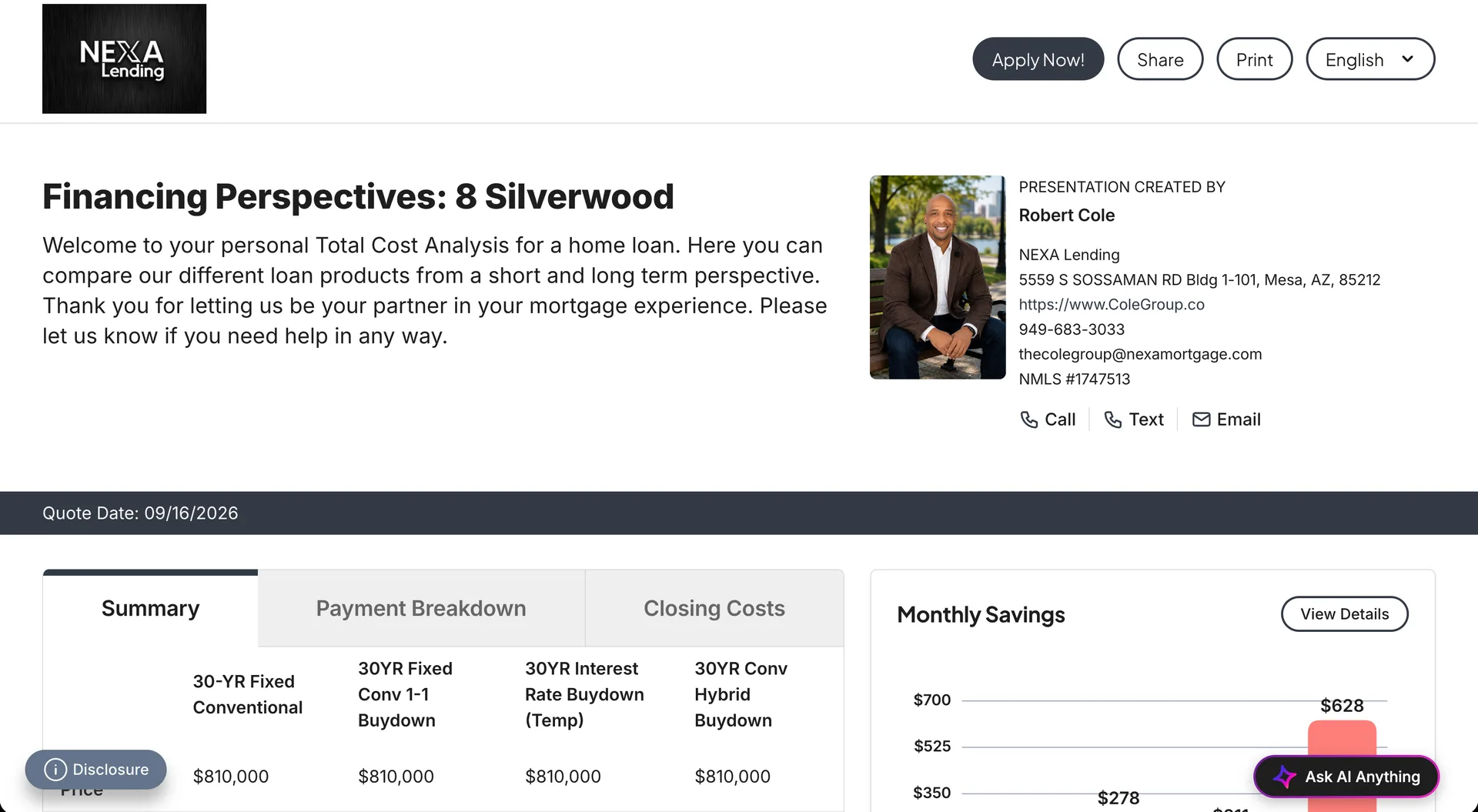
Mortgage Coach also includes an AI assistant that can help a buyer explore questions such as:
- Which scenario costs more over the long term?
- Which scenario results in less interest?
- Which scenario is more cost-effective today?
- What is driving the difference between two scenarios?
The goal is not to make the financing decision for the buyer.
It is to make the differences easier to see.
Explore Financing PerspectivesExplore the financing perspectives for this property
See selected purchase scenarios side by side and explore how different assumptions can change the financial picture.
Open Financing PerspectivesThe bigger idea
Condo financing is not simply about whether a buyer qualifies for a mortgage.
Sometimes the better framework is:
Buyer + property + condominium project + financing strategy
Understanding all four can help a buyer ask better questions earlier, compare alternatives more intelligently, and avoid assuming that one financing scenario represents the entire universe of possibilities.
And because condominium guidelines continue to evolve, the financing approach should always be evaluated using the current program and lender requirements applicable at the time of the purchase.
Explore More of 8 Silverwood
Continue into Market Intelligence, Property Resources, or the Neighborhood sections for additional property information, buyer resources, and local context.